
![]() PLANETARY-
PLANETARY- (note: I'm taking this vol. as a stand alone with no prior knowledge or background) Okay: so this is probably my snobby-academic archaeology background--and throwing around the term archaeological-[superhero] with no prime, rooted passion or dirt-relevance pisses me off--but for someone who's been obsessed with the impossible and even just the
word 'archaeology' since 1rst grade, this little book tag-lined "Archaeologists of the Impossible" just didn't do much in the way of delivery.
Sorry
Warren Ellis... they're not archaeologists! and that's an easy thing to stretch with romanticism and the theoretical, but this stretch is just a bit too far. They're
investigators, private investigators (of crazy monster things--like Scooby-Doo meets the Watchmen meets B movie noir) BIG difference from archaeology in a basic sense (...but we all know archaeology is cooler).
Now, when you take the whole series under the pretenses of...
"The idea of the series is to create a concise world in which archetypes of superheroes, pulp fiction heroes, science fiction heroes, and characters from just about every possible mass media format, live in one large universe while the Planetary team investigates them and ties together the ends." (-'Planetary' wiki)
...Well then, I'm sure that might be an entirely different story. And if I hadn't read Alan Moore's intro. that speaks of this pretense itself, I would have missed out on the story completely.
But don't you think a story should do that on it's own accord? Even just the first volume? Even just the first issue? Though it seemed really promising at first, without that Intro.'s background I would have put it down before it got to "the point" (if there was one in vol. 1).
Interesting concept and whatnot... isn't exactly communicated by the work alone after however many single issues made up the volume itself. Though I suppose comics work much off of reputation and word of mouth, ie. the first vol. of the Runaways was good to okay and now I'm having fan-person issues NOT getting sucked back into it on an hourly basis.
Point, this is what most other people seem to think about Planetary:
"I missed the sneak peek of this series in the previously released Planetary Preview, so this was my first official exposure to the “archaeologists of the impossible” and I was down from the minute Jakita Wagner walked through the door of that diner with the dog urine flavored coffee. In one single issue the entire thing is laid out for you---the fantastic characters, the awe-inspiring visuals, the central mysteries that will ultimately be revealed, and the ideology that will always push the narrative forward. Strange worlds make for strange stories, and what the hell is greater than that? Also worth mention is the first appearance of one Doc Brass, still awake after fifty years for the entire world’s sake, and the explanation of how the Snowflake actually worked. "

It took me many readings of Kurt Busiek's Astro City before I was able to get a hang of the theme and find the city itself as the protagonist--much like here in Planetary, where I think the flavor of the 'mysteries' take over the characterization of the story. I really did like Planetary at first and in theory, but it felt like after pages and pages the "set-up" that seemed like it was leading somewhere at first just got eaten by the show's flare. The larger metaphorical concepts that put EVERYTHING on the table, meshing tons of very different conceptual worlds (each with their own brain-frameworks and distinct metaphors themselves), are fine--difficult for me to digest, but I'm sure some people love to have it all right there. HOWEVER, when they're not grounded in base character development and/or focused individual plotting there's a problem. The reader can get so removed, that they have to 'survive' off of sentiment for those bottle-rockets that the conceptual side of the book is evoking,
with no backbone of it's own but the presentation itself. The reader thus has to make way too much of an effort to
hook themselves.
The single overarching quasi "multi-verse" "quantum computer" theme (that sounds cool but was way too oversimplified to feel like it might sound) that coursed through the book as the obvious generator of ALL of the "mysteries" seemed too self-conscious and dry while being presented as imperative and grandiose.
It, the big glowy "Snowflake" (with infinite individual
UNIVERSES spinning around inside of it that were pictured as little
EARTHS (that looked kind of cheesey)), was supposed to be dramatic or at least
intense--
...all i could think about was the Rainbow Fish from that children's book.


I felt the same here with PLANETARY as
Watchmen made me feel (i.e. ...meh). Only Watchmen had the excuse that the coldwar world was totally outdated, and appreciating it as a youngin now becomes an objective part of the experience.

PLANETARY did what
Watchmen did, in a broad sense, that turned me off. The entire story arc was covered with
the goopy application of a (quasi-scientific) world-view, rigid and a bit too ultimate, which in the process boxed the characters into a pre-determined theoretical 'message'--restricting them from naturally springing forth and blossoming into independent, sentient beings by default. They were restricted from naturally having infinite dimensions themselves, and thus really having space to become a part of the reader on an intimate level or to develop on their own terms.
It's almost like the feeling you'd get reading an 18th or 19th century novel by a christian sympathizer who's using most of the subtleties of the text to project. Not a bad thing, but a product of subjectivity that's too confined to deliberateness while being written (I'm hyper conscious of that mistake, because it's an easy one to get stuck in when you don't think the status is so quo). In 'Planetary v.1.'
The big bad imperative point is kind of just 'meh', or missing, and the characters that revolve around it lack strong enough foundations or exposition to carry the story as the focal point (that's where Watchmen did a much better job).
...Kinda took all of the mystery out of it?
This is the multiverse! Woh, shiney! (or boring?)
What is it? Does Ellis just not have a good sense for drama and human subtlety but is pretty great at everything else? Was that an ignorant statement because I'm not familiar with his other work or where Planetary goes? Maybe it was the story that he was boxed into? Somehow I don't really think so. So maybe he just takes a lot of preliminary time to warm up.
I'm trying, but nothing ever felt imperative for me. Except when the Japanese extremist decided everyone needed to eat dead rotting monster flesh on his gun toating order. I was definitely feeling for his bespeckled side-kick then (who--yay!--stood up to him!). Then the main characters came back and it fell flat again.
But, I really did like the Artemis crew, especially William Leather (well constructed character there, especially visually). And the hot Nazi physicist (until you realize shes probably a hot
nazi, bleh). Also the fact of who the story was ended with holds promise in the larger arc to me. I can't deal with these pulpy 1-dimensional guys though. Also with the non-character-imperative plot drives. Its a thing of mine.
Tomb Raider in all of her Bond-mentality glory was infinitely more identifiable and multidimensional than this leather-dipped chick. She bopped back and forth between somehow looking like the reproducable side of every female action hero I've ever seen and giving off the impression that she was the result of cheap casting of an overly made-up/hackneyed "kick-butt-woman" stand in, the kind that usually appears in soft-core porn or formulaic string budget horror films. (And yeah, it's not lost on me that of course almost all of the girls ever cast as stand-in Lara Crofts for the superficial fan-boys were just what I'm describing Jakita as here).
The costumes side of the characters didn't work for me either... (like no-ones going to look twice at a guy dressed totally in white with white hair walking around with a tall skin-tight red-fringed woman dressed totally in black with black hair.) Ellis was mashing relatively realistic, dirty edged attitudes into a very candy-eyed world and wardrobes and (at least in the first vol.) he never found a middle ground to harmonize that discord. Everyone was too cagey and self-consciously cool.
Except for the diner-waitress, who i think was the best character in the whole thing, but she was an extra.
I liked the deserted monster island metaphor for that period of noir but the way it was inserted in the story didn't work for me...maybe that one was the art. But I just think with what they were trying to do it needed to be done either satirically and in a formulaic story of the month manor, or much more character based and real. It was attempting both and ended up not delivering either successfully.
I know, Warren Ellis is supposed to be this kick-ass legitimized script-writer and how am putting that down, for example, next to Tomb Raider comics (well duh, archaeology). But is that just because those Tomb Raider comics are serialized or is it something more? Because they aren't trying to be anything than they aren't, can't they actually be more successful and go deeper? Like Xena?
Okay, I'm sure as it goes along it probably gets much more concise and worthwhile. But the problem is, this alone didn't make me want to continue: there weren't 'hints' in the writing of things to care about (without trying) in the characters or plot line to come, or of depth and heartstrings and meaning to be teased out. The two main characters (Elija Snow & Jakita Wagner) didn't seem to have any chemistry to speak of, and if you give the writer the benefit of the doubt this
could be intentional and a great source of exposition later on, but again, no hints, subtleties, or hooks--and it's the whole 1rst volume.
Me thinks the setup(&"branding")'s not so good for the general theme and for the concepts to come. If it wasn't for the reputation and "potential" I wouldn't even try to give the doubt-benefits there, but I guess it's just not my bag of tea. Who knows, maybe there's some magic writing thing that happens later that I'd get hooked on and if I read up to vol. 3 it'll be my new favorite thing. I respect Brian K. Vaughan more than any other writer out there and I feel the exact same way about Ex Machina. I also used to feel that way about sushi.
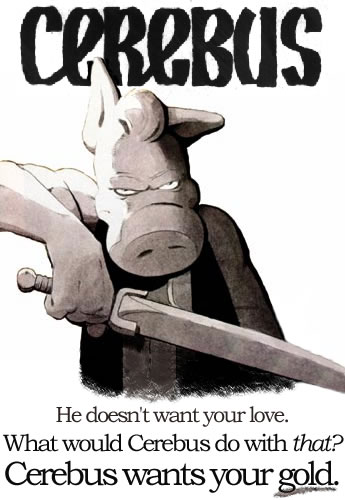
 Though it seems like injustice and just annoying, harsh reality at first glance, when you look at the track record of his "adventures", he continues to get swept up by other people's plots and problems, and idiocy so much, that it seems like Cerebus is unconsciously bringing it upon himself. It's the seed of total alienation combined with the very very buried seed of need to be acknowledged and have human contact. But that's all covered up by lots of booze, scars, and sarcasm.


